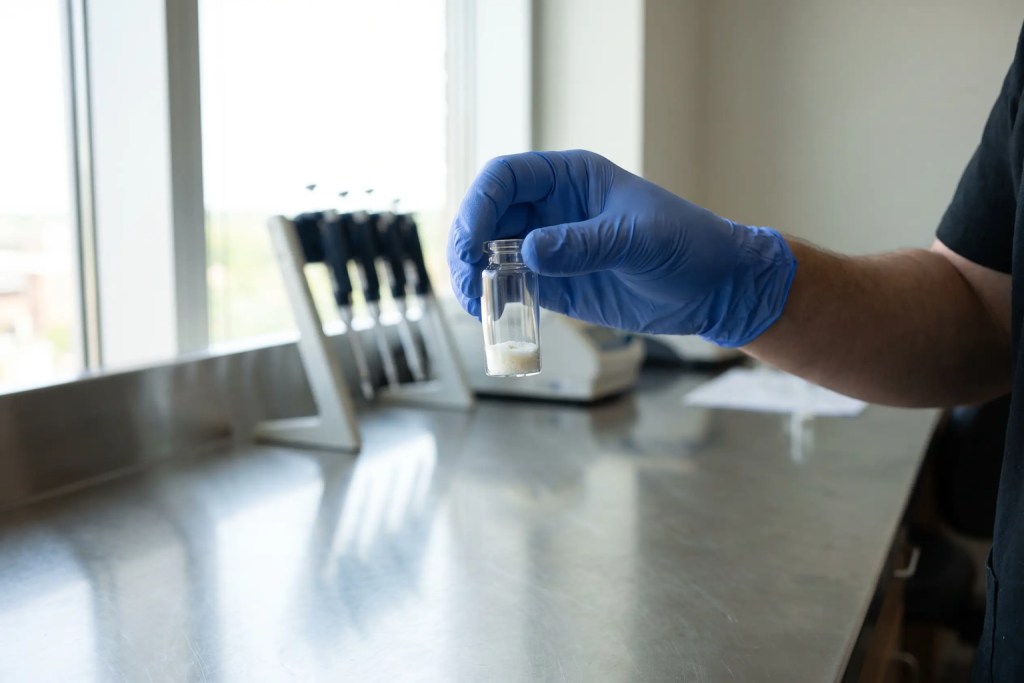
Open a fresh vial of lyophilized peptides, and you might think someone forgot to fill it. A 5 mg sample often looks like a tiny porous white cake, loose powder shaken free in shipping, or a thin film on the glass. You are not looking at a short fill, just pure dry material without bulky filler. That speck holds the full weight of the peptide. Makers freeze the liquid mix and pull the water out under vacuum, leaving a solid built to dissolve fast later. Knowing how that dry form behaves shapes how you store the vial, mix it cleanly, and verify its quality before work begins.
Why Lyophilized Peptides Come as Dry Powder
Dry vials exist because water wrecks fragile amino-acid chains. Left in liquid, water triggers chemical breaks called hydrolysis and deamidation, ruins sensitive residues through oxidation, makes chains clump together in aggregation, and invites microbes to grow. Freezing the solution and removing moisture locks those chains inside a solid state without cooking them with heat. Because molecules cannot move around freely in a rigid solid, unmixed vials handle a few days in a delivery truck far better than liquids do. Kept dry and cold, an unopened vial stays stable for years instead of breaking down in weeks.
How to Store and Mix Freeze-Dried Peptides
Storage Temperatures and Shelf Life
Keep unopened freeze-dried peptides cold, dark, and dry until the exact moment you plan to mix them.
| Storage Condition | Target Temperature | Expected Shelf Life | Key Handling Rule |
|---|---|---|---|
| Long-term dry storage | -20°C (-80°C if oxidation prone) | Multiple years | Avoid frost-free freezers whose warm defrost cycles stress samples |
| Short-term refrigerator | 2°C to 8°C (4°C) | Several months | Store sealed away from damp refrigerator shelves |
| Transit and shipping | Room temperature | Days to weeks | Move straight into cold storage on arrival |
| Moisture and UV control | Cool and dark | Throughout storage | Use dark boxes; warm sealed vials to room temperature before opening so humid air cannot condense on hygroscopic powder |
How to Mix a Vial Without Damaging the Peptide
- Pick your solvent (`0.9% benzyl alcohol` bacteriostatic water for multi-use lab stability, or sterile water or an appropriate buffer for immediate single-use assays), let the sealed vial reach room temperature, and wipe the rubber stopper clean with alcohol.
- Aim the liquid stream slowly down the inside glass wall rather than blasting the fragile dry cake directly.
- Roll or swirl the vial gently until the liquid is crystal clear, never shaking it into foam, because lingering cloudiness or floating bits signal failed dissolution or ruined chains.
- Refrigerate the mixed solution right away at `2°C to 8°C` (`4°C`), use bacteriostatic mixtures within a typical 28-day window after opening, and never subject mixed peptides to repeated freeze and thaw cycles.
How to Check Peptide Quality Before Use
Normal Cake Appearance Versus Warning Signs
A messy vial after shipping does not mean a ruined batch. An intact white or off-white porous cake, crumbled fluffy powder, or a thin glassy film at low masses are all normal and chemically the same. Some compounds also carry natural colors, such as blue GHK-Cu or orange 5-Amino 1-MQ. Real trouble looks wet, shriveled, or burned. Watch out for damp smears, a shrunken sticky or rubbery lump from moisture sneaking past a failed seal, yellow to brown discoloration, or haze that refuses to clear after gentle swirling. A dry crumble mixes cleanly, while those wet warning signs point to real breakdown.
Why Visual Checks Still Need Lab Testing
Even a spotless cake cannot prove purity or tell you how much actual peptide sits in the bottle. You cannot spot leftover salts or broken chains by eye. Dry powder still holds trace bound water and counterions, such as TFA or acetate salts, so net peptide content is always lower than gross dry weight. To verify what is really inside the vial, labs depend on lot tested research peptides for laboratory use backed by independent, lot-matched third-party Certificates of Analysis. Those batch reports pair HPLC purity measurements with mass-spectrometry identity checks so researchers know the sample matches the target sequence before testing begins.
How Freeze-Drying Protects Peptide Chain Integrity
Controlled lyophilization and freeze drying protects fragile amino-acid chains in three careful steps without heat damage. First, rapid freezing drops the mix below its glass-transition temperature (`Tg’`), locking the peptides into a rigid matrix. Next, deep vacuum pulls pressure down during primary drying below the collapse temperature so ice turns straight from solid to vapor, leaving open microscopic channels that make the finished cake dissolve fast. Finally, gentle warming under vacuum during secondary drying strips bound water down below 5%, and sealing under vacuum or inert nitrogen or argon gas keeps oxygen and moisture out.